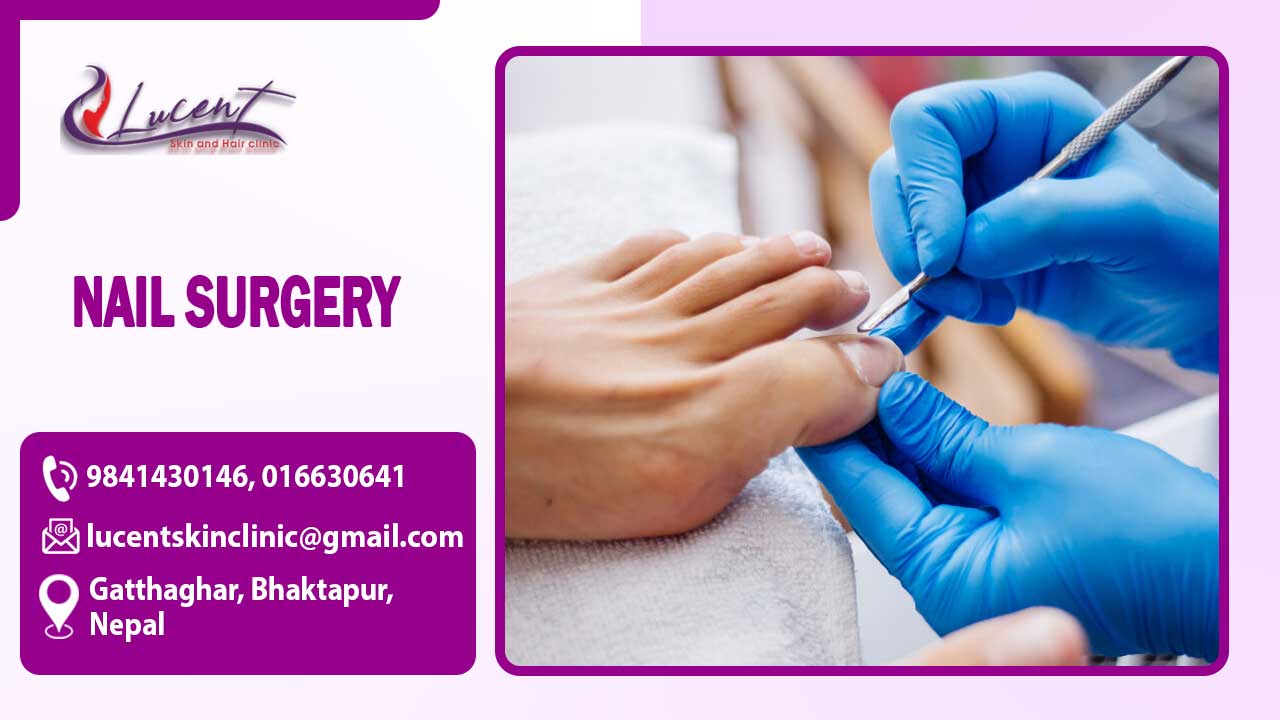
Can a tiny nail cause unbearable pain and make every step feel like torture? If you’ve ever dealt with an ingrown toenail, a split nail injury, or a stubborn fungal infection, you already know how such issues can go from uncomfortable to unbearable very quickly. A swollen nail fold, bleeding edges, or constant soreness in your toe can disrupt everything—from your sleep to your daily walk.
What’s worse is that many people wait too long, hoping it will fix itself or trying DIY methods that only make it worse. Unfortunately, nail issues rarely heal without proper intervention. When left untreated, they can cause serious infections, nail deformities, or even impact how your new nail regrows.
At Lucent Skin and Hair Clinic in Bhaktapur, we offer expert care and safe, medically supervised nail surgery to eliminate the root cause—be it an ingrown nail, thickened nail, trauma, or recurring infection. Our procedures are designed to be quick, painless, and highly effective, helping you get back to your life without discomfort.
If your nail is hurting or infected, don’t ignore it—consult our specialists and walk out pain-free.
What is nail surgery?
Nail surgery is a minor outpatient procedure performed to remove part or all of a damaged or problematic nail. The most commonly performed surgery is nail avulsion, which involves the removal of the nail plate to treat chronic issues such as fungal infection, ingrown toenails, or trauma-related damage.
This procedure is done under local anesthesia and can be completed in under 45 minutes. Depending on the condition, nail removal can be temporary (the nail grows back normally) or permanent (the nail matrix is treated to prevent regrowth).
Common conditions treated through nail surgery:
- Chronic ingrown toenails
- Painful or infected nails
- Nail bed injuries from trauma or accidents
- Persistent fungal infections
- Nail damage caused by artificial nails or improper removal
- Severe nail thickening or deformity
At Lucent, all nail procedures are performed by dermatology-trained professionals using sterile, safe techniques that minimize pain and speed up healing.
1. When is nail surgery needed?
If you’ve been treating your nail with creams, antibiotics, or trimming and it still hurts—or keeps growing back wrong—it’s time to consider nail surgery.
Here are signs you might need professional nail surgery:
- Repeated infections near the nail fold
- Bleeding or pus coming from the nail edges
- Nail cutting into the skin (classic ingrown toenail)
- White, yellow, or thickened fungal nails
- Nail growing unevenly or detaching from the bed
- Pain while wearing shoes or walking
We thoroughly assess your nail condition before suggesting surgery. And if we can treat it conservatively, we always offer that route first. But for chronic or deep-seated problems, nail surgery offers lasting results with minimal downtime.
2. How to remove nail extensions at home – Safely and correctly
With the popularity of acrylics, gels, and builder nails, many people face issues when it’s time to remove extensions. We often see patients at Lucent with nail trauma, pain, or infection caused by improper home removal. So if you’re wondering how to remove nail extensions at home, here’s a safe and dermatologist-recommended guide.
Why removal needs to be gentle
Removing nail extensions improperly can lead to:
- Nailbed injury
- Lifting or detachment of the natural nail
- Cuts or bleeding from rough tools
- Secondary infection under the nail
- Long-term nail plate deformity
Especially if your extensions were applied in multiple layers or with hard glue, patience and the right technique are key.
A step-by-step method to remove nail extensions at home
- Trim the tip
Cut the extended portion using a strong nail cutter. Be careful not to clip too close to your natural nail. - File down the top coat
Use a nail buffer or coarse file to gently sand off the top shiny layer. This allows the acetone to penetrate more effectively. - Soak in acetone
Soak cotton pads in pure acetone, place them on your nails, and wrap with foil. Let sit for 20–30 minutes. - Gently lift with a cuticle pusher
Once softened, gently scrape off the loosened product. Do not force it. If it resists, re-soak for another 10 minutes. - Buff and hydrate
After full removal, buff the nail plate lightly and apply cuticle oil or a hydrating cream to restore moisture.
Important reminders:
- Never pull or peel off extensions
- Don’t use metal tools aggressively
- Avoid using excessive force or sharp edges
- If your natural nail is bleeding, lifting, or painful—see a doctor
In cases where nail extensions cause permanent damage, partial nail avulsion may be recommended to allow healthy regrowth. At Lucent, we often treat such cases with gentle nail trimming, debridement, or matrix preservation to restore nail health.
3. Types of nail surgery in Nepal at Lucent
Based on your condition, one or more of the following surgical approaches may be recommended:
Partial nail avulsion
Removes only the affected portion (usually one side) of the nail. Common for ingrown nails.
Total nail avulsion
Removes the full nail plate to treat severe infection, trauma, or deformity. May be followed by regrowth or permanent removal.
Matrixectomy
Destroys the nail root on one or both sides to permanently stop regrowth. Recommended for recurrent ingrown nails.
Nailbed repair or debridement
In cases of nail trauma, the underlying bed is cleaned, treated, and protected to allow smooth regrowth.
All procedures are done under local anesthesia. Most patients walk out the same day with minimal discomfort and a fully dressed nail.
4. Nail surgery cost in Nepal
At Lucent Skin and Hair Clinic, we offer affordable and transparent pricing for all nail procedures.
Estimated pricing:
- Partial nail avulsion: NPR 2,500 – 3,500
- Total nail avulsion: NPR 4,000 – 6,000
- Matrixectomy: NPR 5,000 – 7,500
- Infection drainage or nailbed cleaning: NPR 1,500 – 3,000
- Dressing and follow-up care: NPR 500 – 700 per visit
You’ll receive a clear treatment plan and cost breakdown after your initial consultation.
5. What to expect before and after nail surgery?
Before the procedure
- Don’t trim or manipulate the nail at home
- Inform us of any underlying health conditions (diabetes, clotting disorders)
- Wear open or loose shoes
- Eat light and arrange a short ride home if needed
During the procedure
- Local anaesthesia is administered to numb the toe or finger
- The affected nail or section is removed painlessly
- The area is cleaned, sometimes cauterized, and dressed
- You can walk immediately afterwards in most cases
After the procedure
- Mild soreness or throbbing is normal for 24–48 hours
- The area must be kept dry and clean
- Full healing typically occurs in 2–4 weeks
- Nail regrowth (if allowed) can take 3–6 months
Our team provides clear dressing instructions and follow-up support to ensure healthy healing.
6. Can the nail grow back after surgery?
Yes, unless a matrixectomy is performed. In most cases, especially partial avulsions, the nail regrows normally and is healthy. If the root is destroyed for permanent results (recommended for chronic ingrown nails), the nail won’t grow back—eliminating recurrence.
We always discuss regrowth options with patients before surgery so you can decide what’s best for your long-term comfort and appearance.
Why choose Lucent Skin and Hair Clinic?
At Lucent, your safety, comfort, and recovery are our top priorities. Whether it’s nail pain, infection, or cosmetic damage, we approach every case with medical precision and genuine care.
Here’s what you can expect:
- Performed by dermatology-trained professionals
- Clean, sterile, and comfortable surgical setup
- Multiple treatment options: partial/total avulsion, drainage, matrix ectomy
- Quick recovery and post-care follow-ups
- Personalized plans for diabetic, elderly, and sensitive patients
From painful toenails to post-extension nail damage, we’re here to restore your nails—and your confidence.
Frequently asked questions
Is nail surgery painful?
No. It’s done under local anesthesia. You may feel slight pressure but no pain.
Can I walk after the procedure?
Yes, in most cases. Open footwear is recommended for a few days.
Will the nail grow back?
Yes, unless the matrix is permanently destroyed. We’ll let you choose your preferred outcome.
How long does recovery take?
Initial healing: 1–2 weeks. Full regrowth (if applicable): 3–6 months.
What if I have diabetes?
We offer safe, tailored care for diabetic patients with proper precautions.
Book your nail surgery consultation today
Your nail might seem small—but the discomfort it causes can take a toll on your life. Whether it’s chronic pain, infection, or trauma from cosmetic extensions, Lucent Skin and Hair Clinic is here to help you feel better, faster.
Get in touch today and experience clean, confident, pain-free nails—starting now.
📍 Location: Gatthaghar, Bhaktapur, Nepal
📞 Phone: +977-9841430146, 016630641
📅 Book Online: Book Now
Say goodbye to nail pain. Step into relief—with expert hands you can trust.
Popular Posts


Recent Posts
-
PRP Hair Treatment in Nepal: Cost, Process, and Results (2026 Guide)
Jul 03, 2026 | Lucent
-
Is Laser Hair Removal Safe? Risks, Side Effects & Safety Guide
Jun 11, 2026 | Lucent
-

Wrinkles on Face: Causes, Types, Prevention and Treatment Guide
Jun 11, 2026 | Lucent
-

Best Laser Hair Removal in Kathmandu – Safe & Long-Lasting Hair Reduction
Jun 11, 2026 | Lucent
-

Best Face Yoga Exercises for a Lifted, Toned & Youthful Face
May 18, 2026 | Lucent
-
How to Identify the Best Skin Clinic in Kathmandu for Safe Treatments?
May 18, 2026 | Lucent
-
Hydrafacial Benefits for Glowing and Healthy Skin
May 18, 2026 | Lucent
-

Laser Hair Removal Price in Nepal: What You Should Expect
May 03, 2026 | Lucent