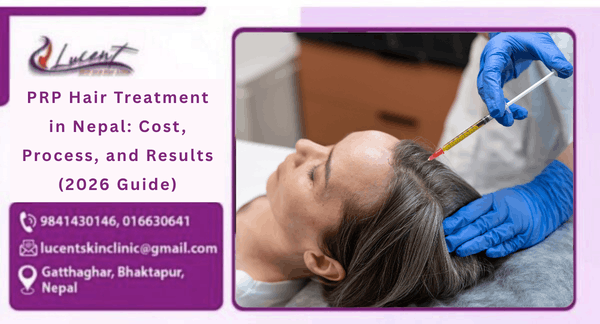
Hair loss may happen to anybody. Usually, it is a gradual process where you notice a couple of additional strands falling off from your head onto your pillow or when you shower.
PRP Hair Treatment in Nepal, also known as platelet-rich plasma therapy for hair loss, has now established itself as one of the most reputable hair loss treatments in Nepal for people experiencing hair thinning. It involves the stimulation of your dormant hair follicles through the use of your own blood. No hair implants. No surgery. No downtime.
If you were looking for PRP Hair Treatment Cost in Nepal or searching for the best PRP Hair Clinic in Nepal, you are not alone; it is one of the very first questions that most people ask. However, cost is not everything. This guide will help you understand PRP hair treatment, including how it works, who can benefit from it, its benefits, and the price.
This article complies with current guidelines in dermatology and is intended to be educational in nature.
What Is PRP Hair Treatment?
PRP is an abbreviation of Platelet-Rich Plasma, sometimes searched as PRP therapy, PRP injections for hair loss, or platelet-rich plasma hair restoration. Platelets are small cells present in blood. These platelets have proteins called growth factors, which help heal tissue injuries. In the case of PRP hair treatment, the platelets extracted from the blood are injected into the hair-thinning areas of the scalp.
These growth factors trigger dormant follicles and increase circulation in the area surrounding the roots. As the plasma is derived from the patient’s own body, the procedure becomes highly customized with a very low chance of allergies. One reason PRP hair restoration in Nepal is gaining popularity as a non-surgical hair loss treatment.
Key takeaway: PRP does not create any new hair follicles; rather, it makes those follicles stronger that are still alive. That is why PRP works effectively on early to moderate hair thinning but not on balding regions.
How PRP Works: The Process
A PRP therapy treatment, sometimes called a PRP hair regrowth session, includes five processes that start from the collection of blood and continue up until the time of recovery. The processes are as follows:
Step 1: Blood Draw
Your blood is drawn by the doctor or nurse by taking a sample of about 10ml to 20 ml from the vein in your arm. This sample size is roughly equivalent to that taken during a standard blood test.
Step 2: Centrifugation
The blood is placed into a sealed vial and then spun inside a medical centrifuge. The process takes around 10 to 15 minutes, as the centrifuge spins the sealed vial at high speed. This process results in the creation of layers within the vial: the bottom layer is made up of red blood cells, while the uppermost layer consists of platelet-poor plasma. The middle layer is known as the platelet-rich plasma and is extracted with the help of a syringe.
Step 3: Scalp Preparation
As the blood is being processed, your head gets ready. This is done by cleaning the treatment area using an antiseptic solution so as to reduce chances of getting infected. In most cases, a numbing cream is applied before allowing 20-30 minutes for it to take effect.
Step 4: PRP Injection
When the scalp becomes numb, the PRP is then injected using a small needle. The injections are made about 1 centimeter apart over the thinned-out scalp at a relatively shallow depth beneath the skin. This is done systematically until the entire treatment area has been covered. The time this process takes is between 15 to 20 minutes, depending on the size of the treatment area.
Step 5: Recovery
The PRP procedure does not have much downtime at all. The patient is usually out of the clinic and gets back into their regular routine. Some signs that you might experience include a little redness, tightness, or sensitivity around the injection site, which should disappear in 24 hours.
From start to finish, including the blood draw, processing, and injections, a full PRP appointment takes about 45 to 60 minutes.
Who Should Consider PRP and Who Shouldn’t?
| Good candidates | Not recommended |
| Early male pattern baldness | Complete baldness (no active follicles) |
| Female pattern hair loss | Active scalp infection |
| Diffuse or early thinning | Blood clotting disorders |
| Hair shedding after illness or stress | Severe anemia or low platelet count |
| Those who want to delay a transplant | Current chemotherapy treatment |
A dermatologist should examine your scalp before recommending PRP. In some cases, a blood test is also useful to confirm you’re a safe candidate.
Benefits of PRP Hair Treatment
PRP Hair Treatment in Nepal offers several benefits for people experiencing hair thinning or early hair loss:
- Non-surgical with minimal downtime: No incisions or stitches, and most patients return to their daily routine the same day.
- Uses your own blood: Since PRP is obtained from your own blood, any chances of allergic reaction are highly unlikely.
- Suitable for men and women: t is highly effective in treating thinning of hair and hair loss in both genders.
- Promotes healthier hair growth: The growth hormones present in PRP have the effect of promoting your hair follicles.
- Can be combined with other treatments: PRP can be combined with minoxidil, finasteride, microneedling, or even hair transplant.
- Quick outpatient procedure: 45-60 minute session per appointment without spending a single night in the hospital.
PRP Hair Treatment Cost in Nepal
Prices will vary in Nepal according to clinic, machinery used, and experience of the doctor.
| Package | Price (NPR) |
| 1 Session | 4,000 |
| 3 Sessions | 10,000 |
| 5 Sessions | 15,000 |
| 7 Sessions | 20,000 |
Note: Prices may vary according to the clinic, machinery and experience of doctor.
Packages with multiple sessions tend to be cheaper compared to single payment for for one session. As part of your initial consultation, our dermatologist will evaluate your scalp condition and then prescribe the most suitable package for you.
What Affects the Price?
Some of the things that would influence PRP Hair Treatment Cost in Nepal would be:
- Experience of the doctor: Doctors who have a lot of experience and skills charge a higher cost for their treatments.
- Quality of the equipment: Quality equipment such as high tech centrifuges and one time use PRP kits.
- Area of treatment: Areas where there is hair thinning.
- Number of visits: Most of the patients require more than one session to achieve optimal results.
- Other procedures: Using PRP along with other procedures such as microneedling, lasers, or medicines used for hair loss increases the cost.
Advice: Never select your clinic solely based on the price factor. Make sure you give importance to the experience and expertise of your doctor.
How Many Sessions Do You Need?
PRP Hair Treatment is a range of treatments instead of a single treatment.
- Initial phase: 4–6 sessions, spaced every 4–6 weeks
- Maintenance phase: 1 session every 6–12 months to help maintain results
What Results Can You Expect?
Results vary from person to person, but many patients notice:
| Timeline | Expected Results |
| 1–2 months | Reduced hair shedding |
| 3–4 months | Stronger, healthier hair with improved texture |
| Around 6 months | Increased hair density and fuller-looking hair |
The success of the procedure is likely to vary depending on many different aspects including age, genetics, hormones, reason for hair loss and stage of the treatment. The patients that have started PRP treatment at the stage when they have only experienced slight hair thinning, are more likely to get positive effects from the procedure.
Side Effects and Aftercare
PRP injections are considered safe because the injections are done by using one’s own blood; therefore, there is a low possibility of having an allergic reaction on the part of the patient due to the PRP injection. The potential side effects of PRP injections include:
- Redness or swelling where the needle was injected
- Bruising or tenderness
- Headache
- Scalp sensitivity
All these side effects will disappear within a day or two.
Aftercare Tips
For proper recovery and to achieve good results:
- Don’t wash your hair within 24-48 hours.
- Don’t scratch your scalp or rub it.
- Don’t dye your hair for several days.
- Do not take part in any strenuous physical exercises on the day of the procedure.
- Staying hydrated is important.
Final Thoughts
Hair loss can impact your self-confidence. If you consult for an effective remedy early, there is a higher possibility of regaining healthy and thick hair. In Nepal, there is an effective non-surgical technique known as PRP Hair Treatment, which involves the use of the natural healing power of your body.
While considering the PRP Hair Treatment Cost in Nepal, it is essential that you do not consider only the cost aspect. The expertise of the dermatologist, the equipment used by him/her and the customized treatment plan all contribute towards a successful outcome.
At Lucent Skin & Hair Clinic, we begin every treatment with a thorough scalp assessment to determine whether PRP is the right solution for you. Our experienced team provides personalized care, transparent pricing, and evidence-based treatments to help you achieve the best possible outcome.
Book Your Consultation Today
Ready to take the next step? Book a consultation at Lucent Skin & Hair Clinic for a professional scalp assessment and a personalized PRP treatment plan. Our experts are here to help you achieve healthier, fuller-looking hair with safe and effective care.
Frequently Asked Questions
1. How much does PRP Hair Treatment cost in Nepal?
PRP Hair Treatment Cost in Nepal depends upon several factors such as the clinic, experience of the physician, facility, and number of sessions that would be required to get the treatment done. PRP packages at Lucent Skin & Hair Clinic cost NPR 4,000 per session.
2. Does PRP regrow hair permanently?
No. PRP treatment increases the health of existing hair follicles, but it will not fix hair loss permanently. Follow-up treatments are suggested at intervals of 6–12 months.
3. Is PRP 100% safe?
PRP is said to be safe as it consists of one’s own blood. When done by an experienced dermatologist following all sterility conditions, PRP has minimal side effects such as redness or soreness at the place of the injection.
4. Is PRP Hair Treatment painful?
Patients will only have mild pain with the shots. Topical numbing cream may be used beforehand to reduce the discomfort.
5. How long does one PRP session take?
An average PRP session lasts about 45-60 minutes. It includes blood drawing, PRP preparation, and scalp injections. With no downtime, you can go back to your daily activities right away.
6. Who is a good candidate for PRP Hair Treatment?
PRP therapy is most beneficial in individuals with early to moderate alopecia where hair follicles are active. PRP may be used for either gender in cases of pattern hair loss or alopecia diffusa. You need to have your scalp evaluated by a dermatologist.
7. How soon can I see results after PRP Hair Treatment?
Some people experience hair shedding that decreases within 2 to 3 months, while hair thickening and densitytake 4 to 6 months. However, the results vary by cause of hair loss.
8. Can PRP Hair Treatment be combined with other treatments?
Yes. The PRP treatment can be used in conjunction with other hair loss treatments including minoxidil, finasteride, microneedling, and hair transplant surgery depending on the type of hair loss you have.
9. Can women undergo PRP Hair Treatment?
Yes. PRP treatment can be used by men as well as women. PRP is frequently applied in treating female pattern baldness, post-partum alopecia, and diffuse hair thinning following a thorough examination.
10. How many PRP sessions are needed for the best results?
Patients generally need 4-6 initial appointments, which are done at 4-6 week intervals. Following the initial therapy, maintenance therapy every 6-12 months is typically suggested to keep up the results.
Popular Posts


Recent Posts
-
PRP Hair Treatment in Nepal: Cost, Process, and Results (2026 Guide)
Jul 03, 2026 | Lucent
-
Is Laser Hair Removal Safe? Risks, Side Effects & Safety Guide
Jun 11, 2026 | Lucent
-
Wrinkles on Face: Causes, Types, Prevention and Treatment Guide
Jun 11, 2026 | Lucent
-
Best Laser Hair Removal in Kathmandu – Safe & Long-Lasting Hair Reduction
Jun 11, 2026 | Lucent
-

Best Face Yoga Exercises for a Lifted, Toned & Youthful Face
May 18, 2026 | Lucent
-
How to Identify the Best Skin Clinic in Kathmandu for Safe Treatments?
May 18, 2026 | Lucent
-
Hydrafacial Benefits for Glowing and Healthy Skin
May 18, 2026 | Lucent
-
Laser Hair Removal Price in Nepal: What You Should Expect
May 03, 2026 | Lucent